
Design transfer is the controlled conversion of verified design outputs into production specifications, captured in the Device Master Record. Start the process during development, not after final validation, so manufacturing capability gets confirmed before release. The anchors are ISO 13485 clause 7.3.8 and the FDA's QMSR, which now maps onto the same clause. Manufacturers build this into pilot runs so capability gaps surface early, not during a launch audit.
TL;DR:
- Effective design transfer begins early in development to identify capability gaps before the final validation and launch stages.
- The Device Master Record must be a living document that includes detailed specifications, work instructions, and traceability, remaining flexible until validation is complete.
- Process validation, including IQ, OQ, and PQ, is essential for critical manufacturing steps that cannot be fully inspected, and must be documented and approved before production start.
- Supplier qualification should occur before commitments, with complete technical data transfers, and clear quality agreements to prevent common handoff failures.
- Continuous transfer practices reduce time to market by catching issues early through cross-functional collaboration and thorough pilot build documentation.
Table of Contents
- What design transfer means for medical devices under ISO 13485 and QMSR
- When to start: three overlapping phases from DfM to production readiness
- The Device Master Record: content and living-document practice
- Process validation: IQ, OQ, PQ, and what auditors want to see
- Handing off to suppliers and contract manufacturers
- Keeping risk management continuous through the transfer
- The design transfer readiness checklist and the DR-6 review
- Best practices that keep design transfer from stalling
- How Emuski structures a practical design transfer
- Why continuous transfer shortens time to market
- Where Emuski fits into your design transfer plan
- Sources
- FAQ
What design transfer means for medical devices under ISO 13485 and QMSR
ISO 13485 treats design and development transfer as a mandatory requirement, not a best practice. It obliges manufacturers to run documented procedures confirming that design outputs are suitable for production before they become final specifications. The FDA's QMSR, effective from 2026, aligns US expectations with that same clause, so a single transfer process now satisfies both regimes in most cases.
Regulators focus here because a device that performs perfectly in a design lab can still fail in a factory that cannot hold the same tolerances, use the same materials, or run the same inspection steps. Inadequate transfer tends to produce the same failures repeatedly:
- Rework loops when production discovers a drawing doesn't match the tooling
- Audit findings citing missing traceability between design inputs and manufacturing records
- Field corrections or recalls traced back to a process nobody actually validated
- Delayed launches because supplier qualification started too late to catch capability gaps
When to start: three overlapping phases from DfM to production readiness
Design transfer isn't a single event that happens after signature. It runs across three phases that overlap deliberately, so manufacturing input shapes the design rather than reacting to it.
- Design for manufacturability (DfM), early. Bring manufacturing engineers into design reviews while geometry, materials, and tolerances are still flexible. Catching a moulding constraint here costs a meeting; catching it after tooling is cut costs weeks.
- Pilot production during verification. Build pilot units on production-equivalent equipment and processes, and capture cycle times, yields, and deviations as they happen rather than reconstructing them afterwards.
- Production readiness, post-validation. Once IQ, OQ, and PQ are complete, finalise the DMR and lock the version. This phase confirms the plant can repeat what the pilot proved, not just once.
The Device Master Record: content and living-document practice
The DMR is the single deliverable that makes or breaks a transfer, because it's the document manufacturing actually works from. A complete DMR typically covers:
- Final drawings and specifications for every component and assembly
- Bill of materials with approved suppliers and part revisions
- Manufacturing and assembly work instructions
- Inspection and test criteria, including sampling plans
- Labelling artwork and packaging specifications
- Traceability requirements linking lots, components, and finished units
Design outputs, risk analyses, and verification records stay in the Design History File as evidence of how the design was reached. The DMR, by contrast, is what production reads every shift. AAMI's guidance treats the DMR as the artefact that must stay traceable back to design outputs at every revision. Practical guides go further, noting the DMR should also absorb manufacturing-generated artefacts such as equipment maintenance and calibration procedures, not just transcribed design files.
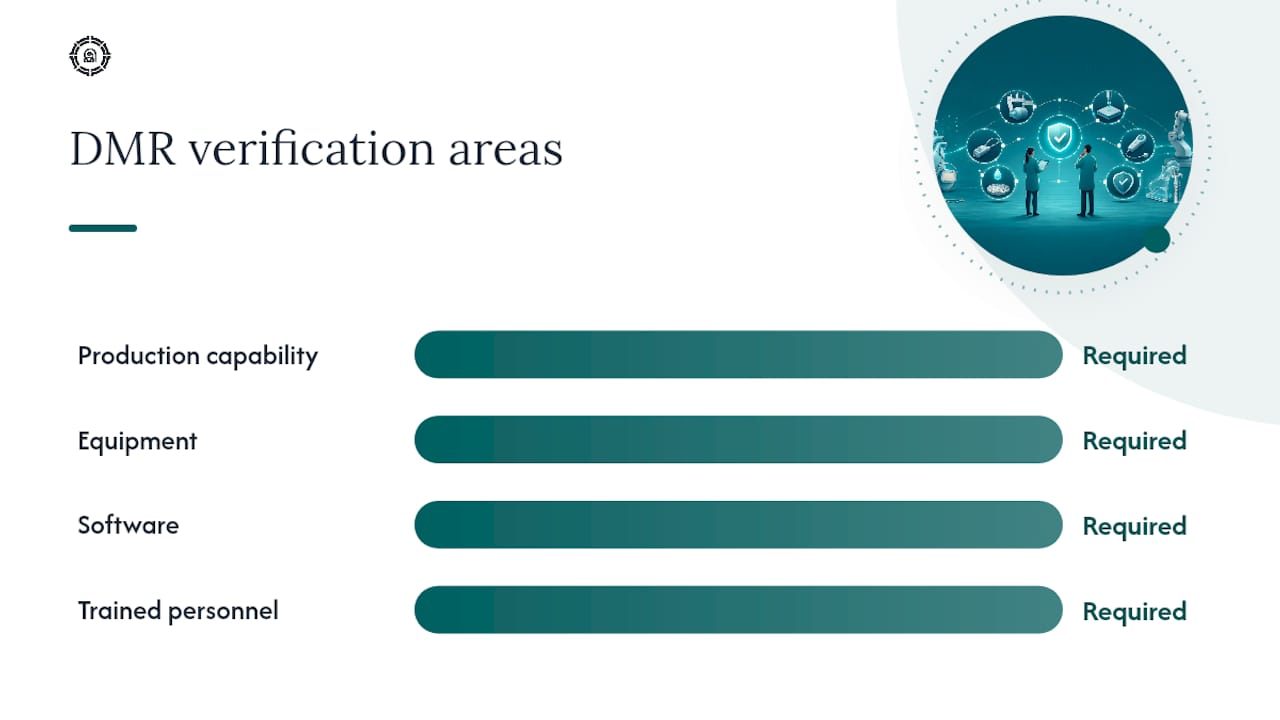
Pro Tip: Don't lock the DMR the moment design signs off. Treat it as a living document until production capability, equipment, software, and trained personnel have all been verified against it. Locking early just means a second round of change control a month later.
Process validation: IQ, OQ, PQ, and what auditors want to see
Installation Qualification (IQ), Operational Qualification (OQ), and Performance Qualification (PQ) confirm equipment is installed correctly, runs within its specified parameters, and produces conforming output consistently over time. Validation gets triggered whenever a process's output can't be fully verified by inspection alone, which covers most of the processes medical device manufacturers rely on:
- Sterilisation cycles, whether ethylene oxide, steam, or radiation
- Injection moulding and other processes with variable, hard-to-inspect parameters
- Software-controlled manufacturing or test steps
- Bonding, welding, or sealing operations that can't be non-destructively verified per unit
Auditors expect protocols written and approved before execution, defined acceptance criteria, and reports that trace results back to those criteria. One recurring theme across practical guides is that a manufacturer's own design transfer checklists increasingly build process validation status into the release gate itself, rather than treating it as a parallel workstream that catches up later.
Handing off to suppliers and contract manufacturers
A supplier handoff fails less often because of a bad supplier and more often because the technical package handed over was incomplete. ISO 13485 requires evaluating and selecting suppliers based on their ability to meet requirements, which means the qualification step has to happen before commitments get made, not after the first bad batch.
A workable handoff sequence looks like this:
- Audit the supplier's QMS against ISO 13485 requirements, not just a general capability questionnaire
- Transfer a complete technical data package: drawings, process parameters, and acceptance criteria
- Run trial builds and a first article inspection (FAI) before committing to volume
- Formalise a quality agreement covering change notification, non-conformance handling, and audit rights
Practical guidance consistently flags labelling and traceability requirements as the items most often missed in supplier packages, largely because they sit outside the core drawing set that gets the most attention.
Keeping risk management continuous through the transfer
Risk controls decided during design only mean something if manufacturing actually enforces them. Traceability between the design outputs, the ISO 14971 risk file, and the process controls on the shop floor is what proves that continuity to an auditor.
Process FMEA (PFMEA) is the practical tool here. It works down from the risk file to identify which process parameters are critical to safety or performance, then feeds those parameters directly into validation test plans and in-process inspection points.
- Map each design-stage risk control to a specific process step or inspection
- Use PFMEA outputs to set which parameters get 100% inspection versus sampling
- Re-assess the risk file after pilot builds and FAI, since real production data often reveals failure modes the design team never modelled
- Keep the updated risk file as part of the transfer record, not a separate archive
The design transfer readiness checklist and the DR-6 review
Before production release, gather the evidence that proves the device is ready, not just that the paperwork exists. A working readiness checklist typically includes:
- A completed and version-locked DMR
- IQ, OQ, and PQ reports with signed-off acceptance criteria
- Supplier qualification records and an executed quality agreement
- Production personnel training records
- First-article inspection data matching specification
The formal design transfer review, often labelled DR-6 in a phase-gated development process, is where cross-functional sign-off happens: quality, manufacturing engineering, regulatory, and design engineering all need a seat at that table, because each owns a different piece of the evidence.
| Review outcome | What it means | Typical next step |
|---|---|---|
| Full approval | All checklist items closed, no open deviations | Release to production |
| Conditional approval | Minor open items with defined closure dates | Release with tracked actions |
| Rejection | Critical gaps in validation or DMR | Return to pilot phase, re-review |
Best practices that keep design transfer from stalling
- Bring manufacturing engineers into DfM reviews from the first prototype, not the final one. Iterating on manufacturability early is far cheaper than redesigning tooling after transfer starts.
- Document pilot builds as they happen. Photos, cycle times, and deviation notes captured live speed up work instruction completion far more than reconstructing them from memory weeks later.
- Never let DMR finalisation slip to the last week. A rushed DMR is where labelling errors and missing traceability links hide.
- Build change control into the supplier handoff itself, so a component revision after launch triggers the same scrutiny it would have received during transfer.
Pro Tip: If your pilot build schedule keeps slipping, that's usually a signal the DfM phase started too late, not that the pilot team is underperforming. Fix the timing, not the symptom.
How Emuski structures a practical design transfer
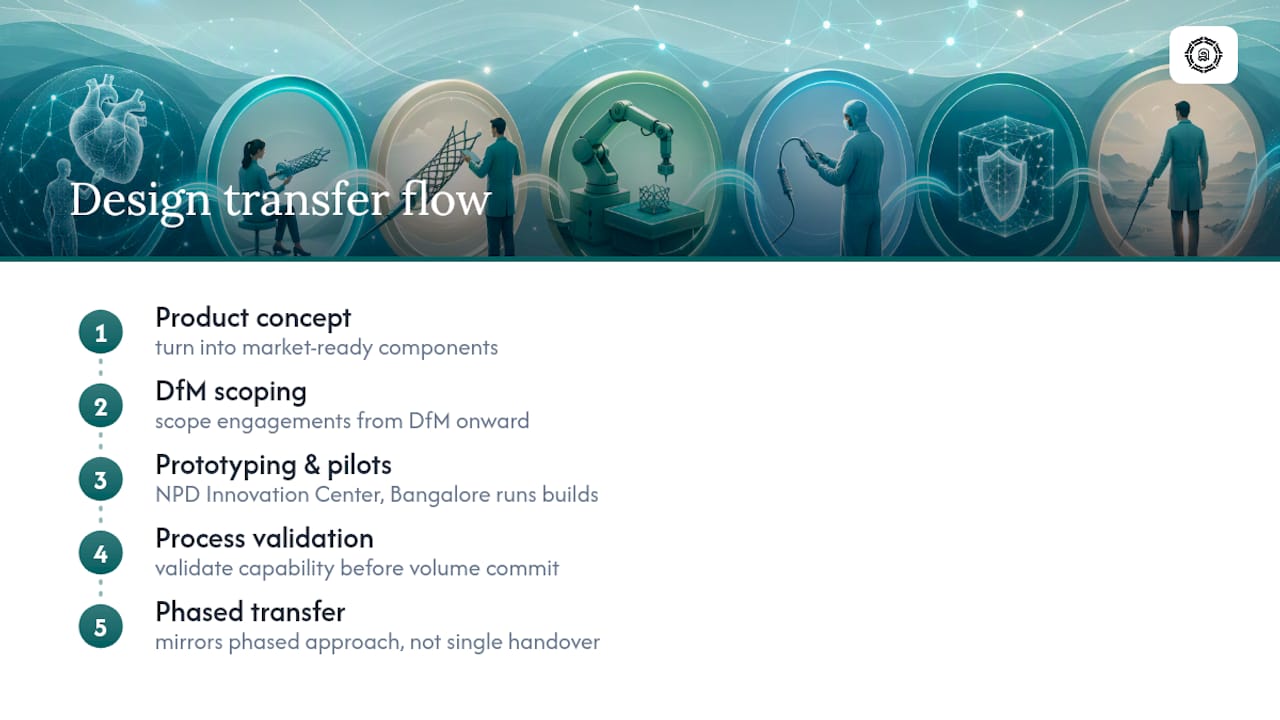
Emuski is an ISO certified manufacturer built around turning product concepts into market-ready components, and design transfer sits at the centre of that work. Its NPD Innovation Center in Bangalore runs rapid prototyping and pilot builds specifically to validate process capability before a client commits to volume production, which mirrors the phased approach outlined above rather than treating transfer as a single handover event.
drawn from teardown analysis and strategic sourcing work that typically accompanies a transfer engagement. informs how these engagements get scoped from the DfM stage onward.
Why continuous transfer shortens time to market
Treating transfer as a continuous thread from DfM through pilot to production readiness, rather than a single gate at the end, tends to cut scale-up time and reduce audit queries. Fewer field failures follow directly from fewer unvalidated assumptions carried into volume production.
Cross-functional gate ownership matters more than any single document. Teams most often underinvest in pilot build documentation and supplier verification, precisely the two areas that surface problems earliest when done properly.
— Nya
Where Emuski fits into your design transfer plan
Emuski works as the manufacturing partner you bring in during DfM, not after your DMR is already stuck in review. Where many teams discover manufacturability gaps at pilot build, Emuski's approach folds DFM optimisation into the design phase itself, using AI-driven cost estimation to flag tooling and process risks before they become validation failures.
Its manufacturing services cover rapid prototyping, pilot runs, and on-demand production on the same equipment lines, so a pilot build actually reflects what full-scale production will look like. For the supplier side of transfer, strategic sourcing support helps qualify contract manufacturers and build the technical data package before commitments get locked in. If your transfer plan has gaps in DfM, pilot validation, or supplier qualification, request a transfer readiness review with Emuski's engineering team and get a scoped assessment before your next design review.
Sources
For clause-level detail, the ISO 13485 standard page is the primary reference for design and development transfer requirements. AAMI's published analysis of design transfer remains a solid grounding in DMR traceability principles.
- ISO 13485 — Medical devices — Quality management systems
- Design Transfer to Manufacturing: DMR, Validation, and Supplier Handoff | MedDeviceGuide
- Design Transfer and Successful Product Development (AAMI article)
- Design Transfer: Definition, Requirements, and Implementation | QMSDoc
FAQ
Is a CE mark equivalent to FDA clearance?
No. A CE mark shows conformity with EU medical device regulations, while FDA clearance or approval is a separate US regulatory pathway with its own submission requirements. Design transfer documentation, particularly the DMR and validation records, typically supports both, but the regulatory dossiers and review bodies are distinct.
What does ISO 13485 require for design transfer procedures?
ISO 13485 clause 7.3.8 requires documented procedures ensuring design outputs are verified as suitable for manufacturing before becoming production specifications. This includes confirming that equipment, personnel, and processes can reliably reproduce the verified design.
What is the definition of design transfer?
Design transfer is the controlled process of converting verified design outputs, drawings, specifications, and work instructions, into approved production documents, primarily the Device Master Record. It confirms manufacturing can reliably reproduce the device as designed before commercial release.
What are the typical stages of a design transfer?
Most transfer processes move through overlapping phases: early manufacturing involvement during DfM, pilot production during verification, and production readiness confirmation once process validation is complete. Some frameworks describe additional sub-stages for supplier qualification and formal sign-off, but the core progression stays the same across ISO 13485 and QMSR guidance.
Can Emuski support process validation and supplier handoff during transfer?
Emuski's manufacturing services include pilot production runs and on-demand manufacturing that support IQ, OQ, and PQ evidence gathering, alongside strategic sourcing support for supplier qualification. Pricing for cost engineering and DFM work is available on request through Emuski's cost engineering services page.